
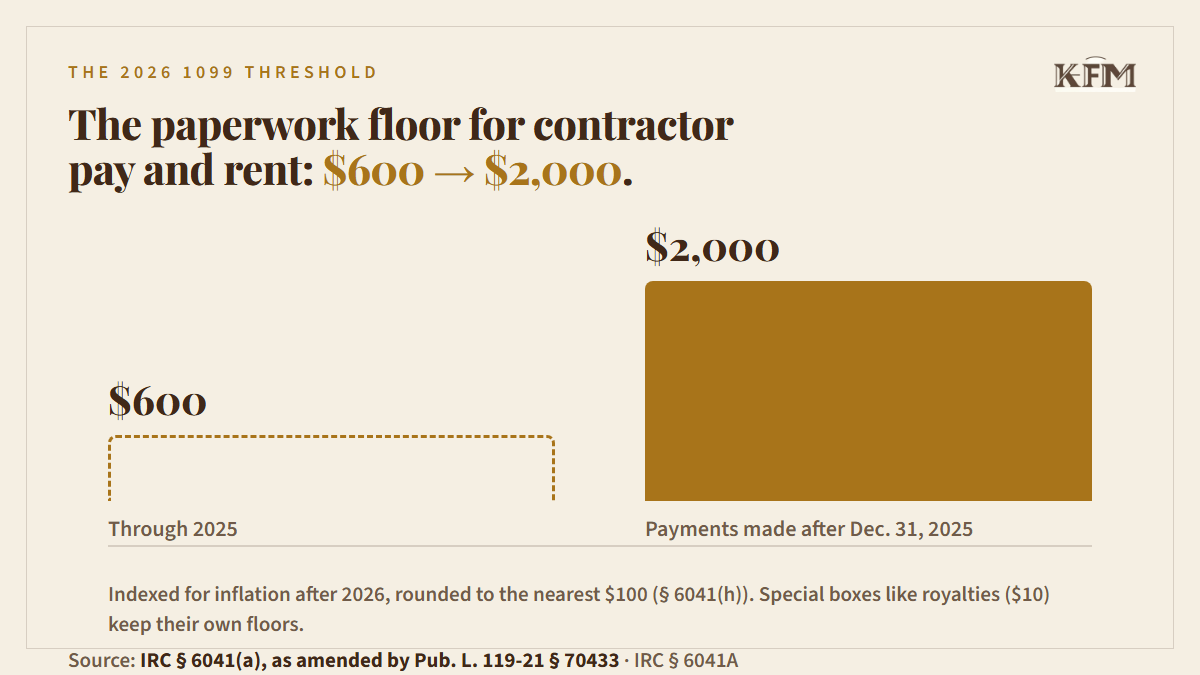
Starting with payments made after December 31, 2025, the threshold that obligates a business to issue a 1099 on contractor pay and rent is $2,000, up from $600. Congress made the change in the July 2025 budget law (Pub. L. 119-21), which struck "$600" from IRC §6041(a) and wrote in "$2,000." The statute on the books today requires an information return for trade-or-business payments "of $2,000 or more in any calendar year."
For payers this is straightforward relief. If your business pays contractors, freelancers, or a landlord, you now track one number per payee per calendar year: $2,000. The two forms in question are the 1099-NEC, which covers payments for services under §6041A, and the 1099-MISC, which covers rent and other trade-or-business payments under §6041. Reach the line and a form is due; stay under it and those service and rent payments alone require no form. A few special 1099-MISC categories keep their own lower floors, untouched by the new law: royalties at $10 (§6050N) and gross proceeds paid to attorneys at $600 (§6045(f)) are the two most owners meet. The IRS's December 2026 form instructions already carry the new number, telling payers to file a 1099-NEC for each person paid at least $2,000 in nonemployee compensation, and they flag a possible inflation adjustment beginning in 2027.
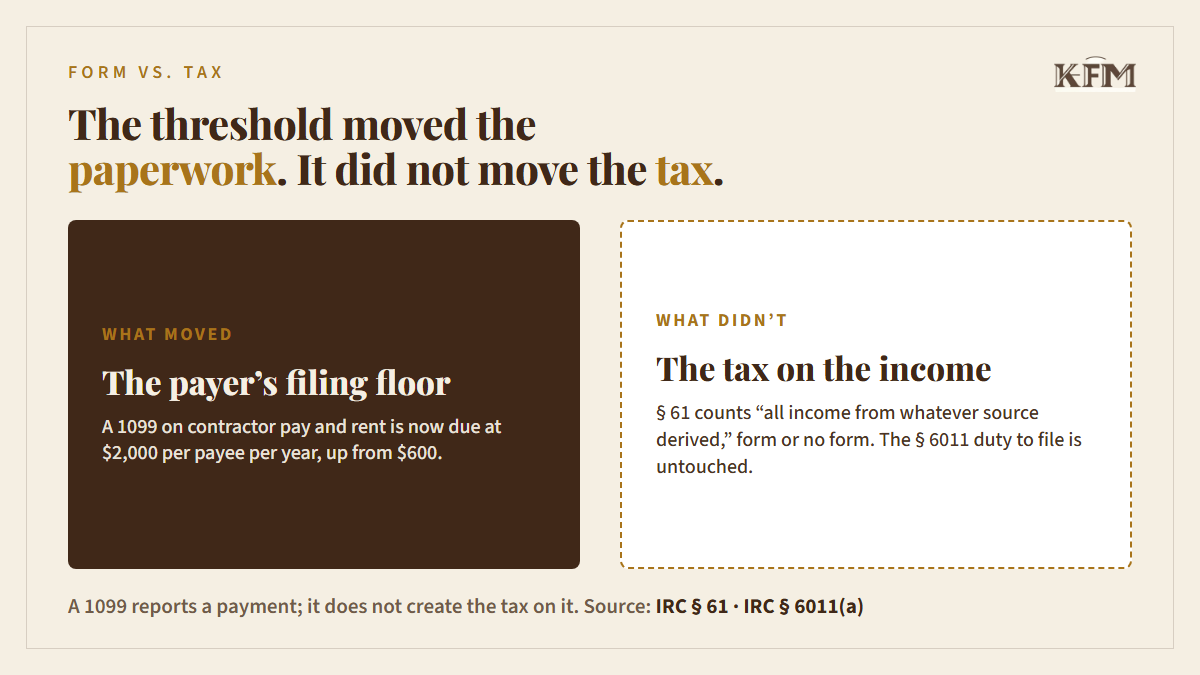
The misreading to avoid sits on the other side of the form. A 1099 is an information return: it tells the IRS that a payment happened. It has never been the thing that makes the payment taxable. That job belongs to §61, which defines gross income as "all income from whatever source derived," and the new law did not touch it. Congress amended the reporting and withholding sections (6041, 6041A, 3406) and left §61 exactly as it was. A contractor who is paid $1,800 by a client during 2026 will get no form the following January and will still have $1,800 of gross income, includible on the return whether or not anything arrives in the mail. The duty to make a return when you owe tax sits in §6011(a), and the July law left that filing rule alone too. The threshold moved the payer's paperwork obligation. The payee's side did not move at all.
Backup withholding carries over intact. When a payee has not furnished a valid taxpayer identification number, §3406 requires the payer to withhold, currently at 24%, once payments reach the reporting threshold. Congress conformed that statutory trigger to the new $2,000 line in the same law, and it is in force now. The Treasury regulations that would conform the regulatory fine print are, as of this writing, only proposed: REG-113229-25, published April 17, 2026, with proposed applicability to payments made on or after January 1, 2026. A proposed regulation is not final law, so where a mechanical detail turns on those regs, treat the answer as provisional until Treasury finalizes them.
The $2,000 is not permanent either: for calendar years after 2026, §6041(h) indexes it for inflation, rounded to the nearest $100, so the federal line will drift upward. And it is a federal threshold; Florida, with no personal income tax, adds nothing on top.
Raising the paperwork floor is not lowering anyone's tax.
Comments