
The One Big Beautiful Bill Act has one number everyone quotes: the SALT cap, which jumped from $10,000 to $40,000 for 2025. In New York or New Jersey that headline earns the attention. Read the same law from Florida and the section that matters more is quieter and got far less attention. It resets the standard deduction.
For 2025, mortgage interest, property tax, and charitable gifts only reduce your tax if you itemize, and itemizing is an election under IRC 63(e). Make no election and the standard deduction applies on its own.
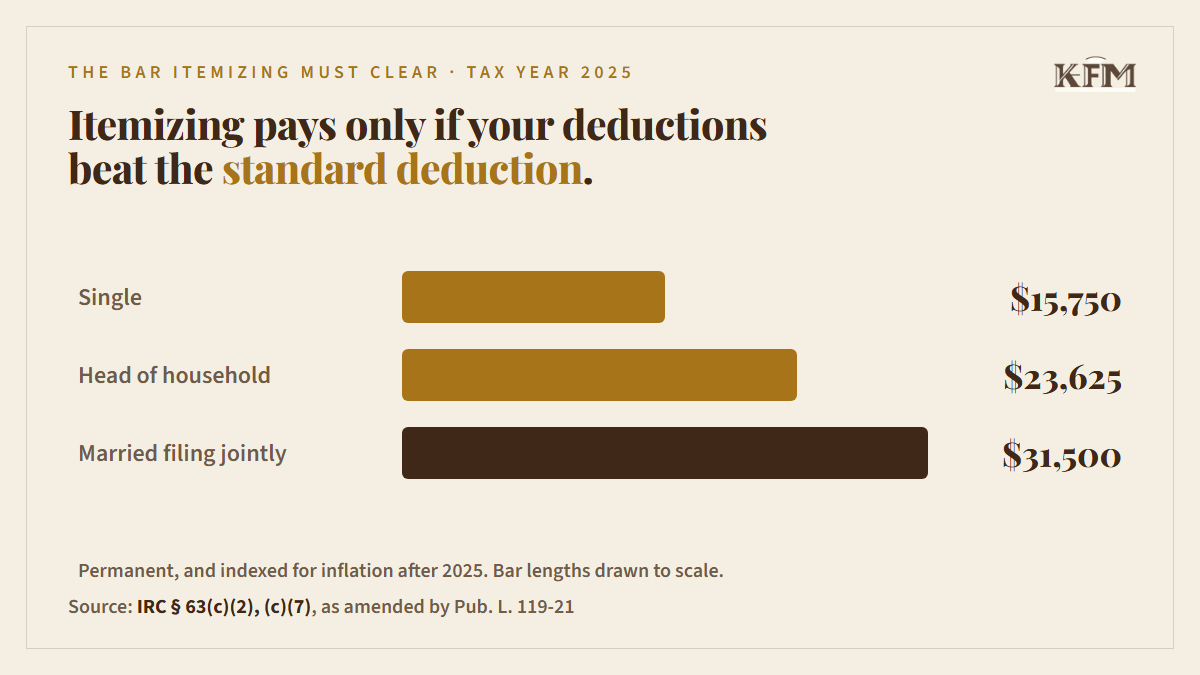
So itemizing pays off only when your deductions, added together, beat the standard amount. For 2025 that bar sits at $15,750 for a single filer, $23,625 for a head of household, and $31,500 on a joint return; the statute sets the joint figure at 200 percent of the single one. If the number in your head is older than a few years, it is too low. And the bar is permanent: IRC 63(c)(7) carries no expiration date, and the amounts index for inflation starting in 2026. All of these are federal figures for tax year 2025.
The list of what a Floridian can put under the SALT cap is short. The deduction covers state and local income taxes, property taxes, and, by election under IRC 164(b)(5), general sales taxes in place of income taxes. Florida levies no personal income tax, so the item that pushes a Connecticut filer toward the cap does not exist here. A Florida return stacks property tax, perhaps the sales-tax election, and stops. Both count inside the cap. Both require itemizing in the first place. Without a state income tax underneath it, $40,000 of cap is a long way above an ordinary property-tax bill.
Itemizing still wins on some Florida returns. Interest on a large, recent mortgage can clear the bar by itself. Sustained charitable giving can do it. So can the property tax on a high-value home, with the sales-tax election stacked on top. The test stays the same in every case: total what you could itemize, compare it to $15,750 or $31,500, and itemize only if the total is bigger.
Filers 65 and older get a separate deduction, and it is easy to misread. For tax years 2025 through 2028, IRC 151(d)(5)(C) allows an extra $6,000 deduction for each person on the return, taxpayer or spouse, who has turned 65 by year end. It stacks on top of the standard deduction rather than replacing any of it, and it applies whether you itemize or not. It phases down by 6 percent of modified adjusted gross income above $75,000, or $150,000 on a joint return; it requires the qualifying person's Social Security number on the return; and a married filer must file jointly to claim it.
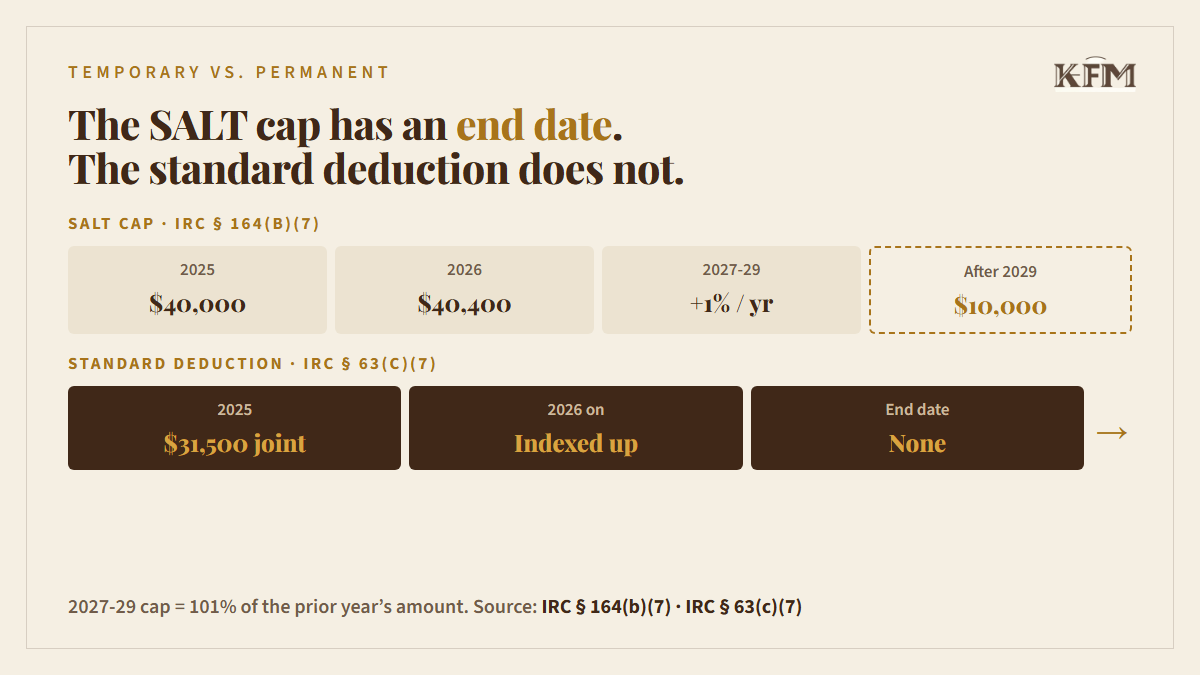
The two changes also age differently. The enlarged SALT cap is temporary: $40,000 for 2025, $40,400 for 2026, then 101 percent of the prior year's cap through 2029, then $10,000 again for tax years beginning after 2029. It phases down for high earners too, by 30 percent of modified adjusted gross income above $500,000 for 2025, though never below $10,000. The standard deduction has no reversion date at all. The SALT relief only matters where a large state and local tax bill exists to stack under it, and it is built to expire. The bigger standard deduction reaches filers in every state, and it stays.
A cap only matters if you were ever going to reach it. The standard deduction sets the bar every time the itemize-or-not choice comes up, every year. The question worth asking each spring is the one this law just made harder to answer with yes: does your itemized total clear the standard deduction?


Comments