
The federal government will put $1,000 into a savings account for a child born after December 31, 2024 and before January 1, 2029. That is the piece of the new Trump account rules that reached the news.
The employer half of the same law got much less attention. Under section 128 of the tax code, your business can contribute up to $2,500 a year into one of these accounts for an employee, or for that employee's dependent child, and the money is excluded from the employee's income. It never arrives on their W-2 as wages.
If you run a business that cannot match a national employer's 401(k), a benefit shaped like that is worth understanding early. The catch is that as of the end of July 2026 you cannot set it up correctly, because the rule explaining how to run the program has not been written.
Everything below is quoted from two proposed regulations published March 9, 2026: REG-117270-25 on Trump accounts, and REG-117002-25 on the federal contribution pilot. I also read the June 5 hearing notice and searched the Federal Register and the Code of Federal Regulations for anything final.
The name hides what the account actually is. The proposed regulation describes a Trump account as "a type of traditional IRA described in section 530A(b)(1) for the exclusive benefit of an eligible individual," and says "the rules under section 408 that apply to other traditional IRAs are generally applicable to Trump accounts, except as provided in section 530A(h)." That makes it less exotic than the branding suggests: an IRA opened for a child, carrying a layer of special rules that mostly apply while the beneficiary is young. If you already know how an IRA behaves, you already know most of how this one behaves. All of it comes from one statute, section 70204 of Public Law 119-21, signed July 4, 2025, which added sections 530A, 128, and 6434 to the Code.
Two numbers govern how much reaches the account, and only one of them is yours. Contributions to a Trump account are "subject to an annual limit of $5,000, adjusted for inflation." Employer contributions under section 128 are excluded from the employee's income "up to an annual limit of $2,500."
The sentence most summaries skip is the one that connects them. The regulation states plainly that "section 128 employer contributions count towards the $5,000 annual contribution limit." Your $2,500 fills half of a ceiling that already existed, rather than adding room on top of it. For an employee whose family was going to fund the account anyway, your money substitutes for money that was already going in, and that is worth knowing before you build a recruiting pitch on it.
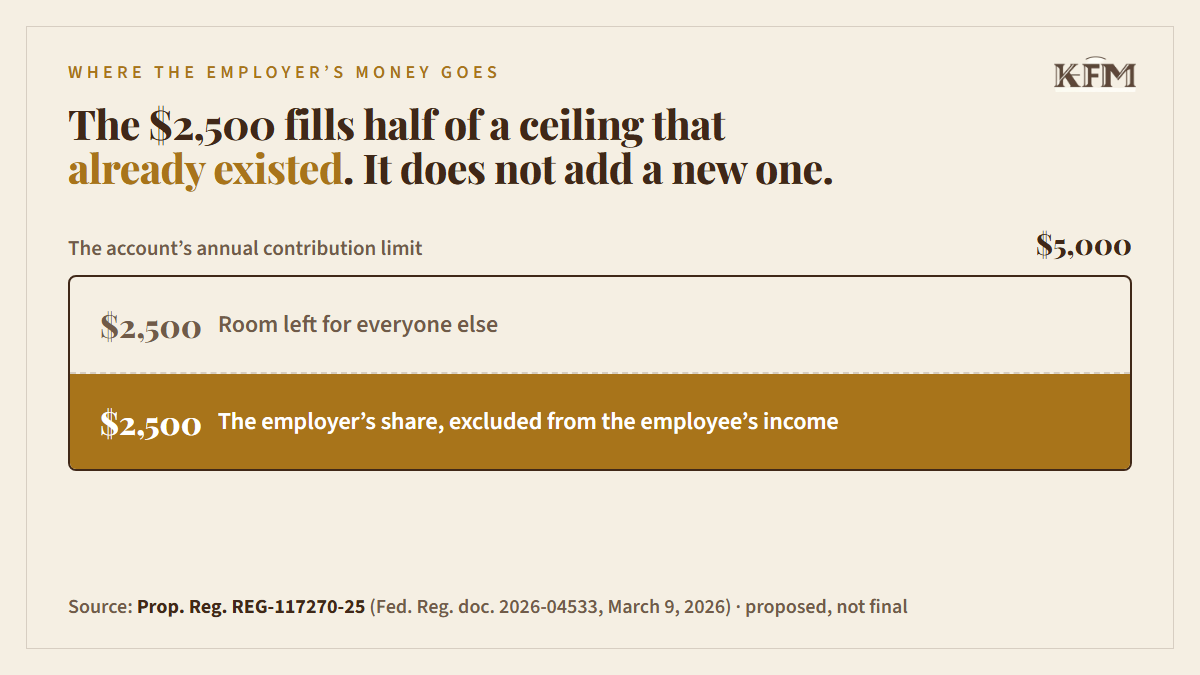
The $2,500 is at least stable for the moment. The proposed rule limits the contributions to "$2,500, subject to cost-of-living adjustments after 2027," so there is no inflation math for you to do yet.
One sentence decides whether any of this is a 2026 action item. Section 128 employer contributions, the regulation says, "must be made pursuant to a section 128(c) Trump account contribution program." The proposed regulation does not define what such a program requires. It notes, in a parenthetical, that "the Treasury Department and the IRS intend to issue guidance under section 128 at a future date." Until that guidance exists, there is nothing for you to hand a payroll provider.
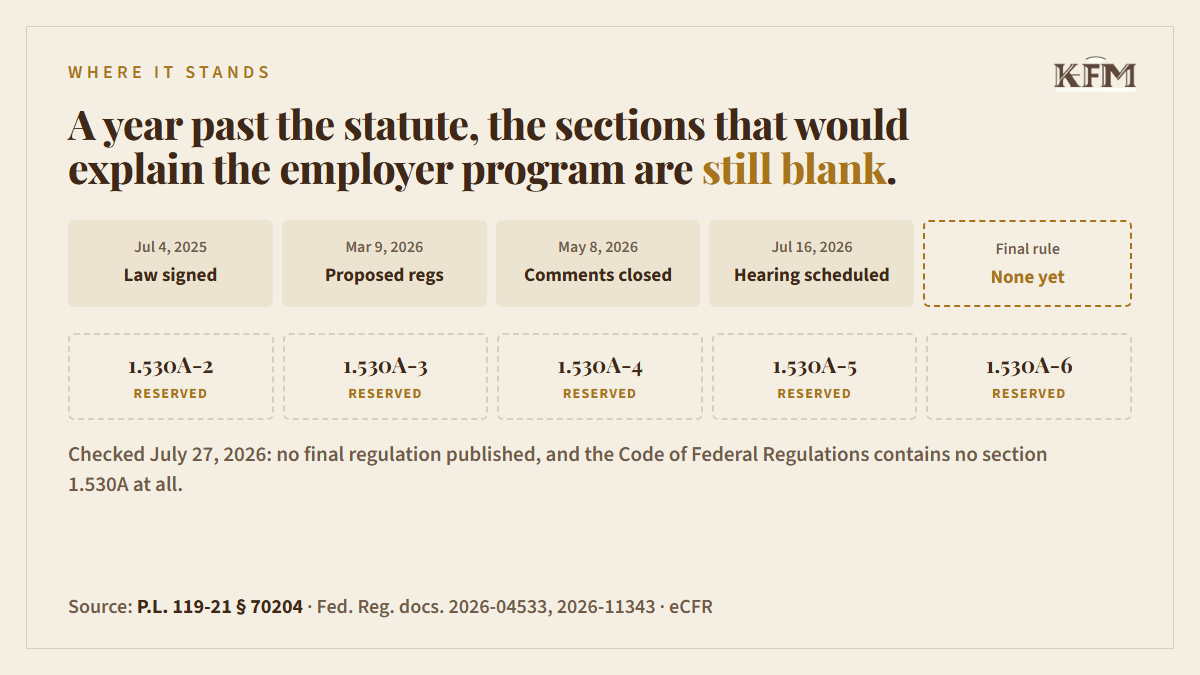
The gap shows up in the regulation's own structure. Proposed sections 1.530A-2 through 1.530A-6 are published with "[Reserved]" standing in for their text. Congress wrote the number into the statute. The agency has not yet written the instructions for using it.
The process has been moving and still has not landed. The statute was signed July 4, 2025. Proposed regulations appeared March 9, 2026. The comment period closed May 8, 2026, and a public hearing was scheduled for July 16, 2026. As of this writing, no final regulation has been published, and the Code of Federal Regulations contains no section 1.530A at all.
You could reasonably ask why any of this matters before it works. "Excluded from the employee's income" is an uncommon feature, and most ways of handing your employee $2,500 cost them tax on it. This one, as drafted, does not. When the section 128 guidance arrives, the owners who already understand the mechanics will be deciding while everyone else starts reading. Benefit changes are easier to plan in a quiet quarter than in the one where a new rule lands.
What I would not do is act on a proposed regulation. Proposed rules change between draft and final, sometimes in ways that matter, and every figure above carries that caveat. Nothing here is a plan document, and none of it is a reason to promise your people anything yet.
The honest position on Trump accounts is narrower than the coverage around them. There is a real employer benefit sitting in the statute, capped at $2,500, consuming half of a $5,000 annual ceiling, and it is not usable until Treasury writes the program rules. Whether that takes months or most of a year, I don't know. The shape of it is knowable now, which is the only reason to spend your time on it this early.
If you are already sketching what to offer employees next year, reply with your entity type and headcount and I'll tell you where something like this would sit against what you already have.
Comments