
199 payments through a platform in a year, $18,000 in all. Both figures sit under the restored 1099-K reporting threshold, and the platform still has to withhold federal tax from every one of them.
The figures are the IRS's own, from Example 2 of a regulation finalized on August 10.
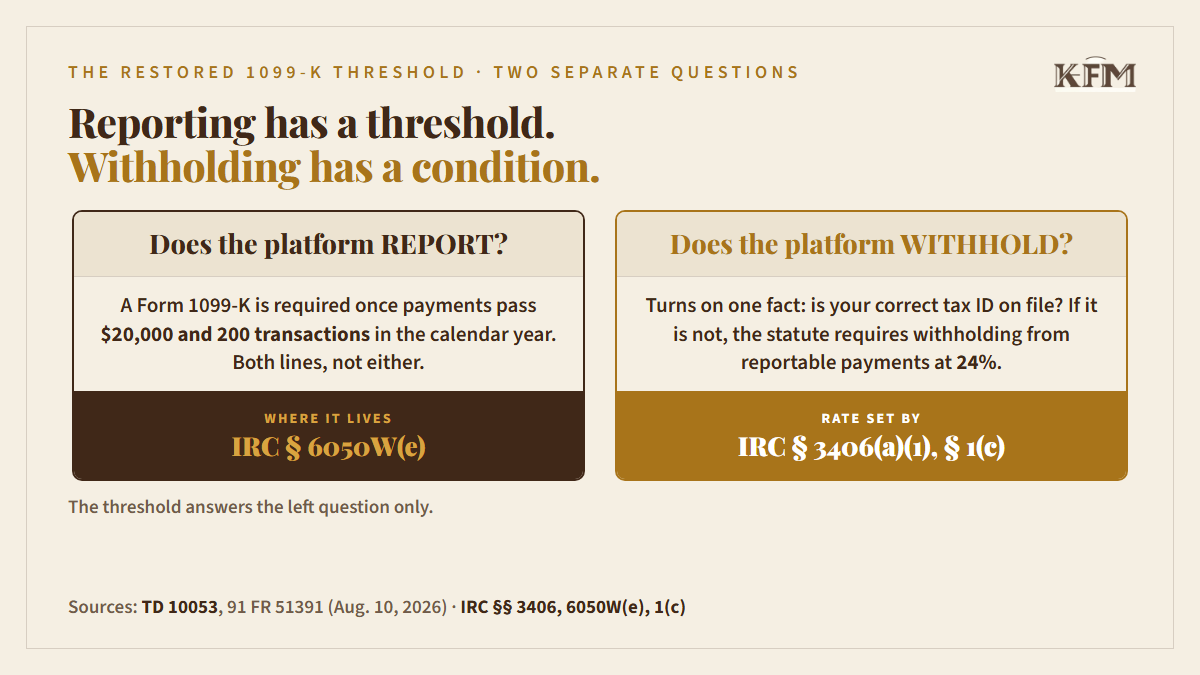
Congress put the old 1099-K threshold back last year. A payment platform or online marketplace now sends the IRS a Form 1099-K for you only once your payments pass $20,000 and 200 transactions in a calendar year. I wrote in July about what that restoration changes, which is reporting, and what it leaves alone, which is the tax on the income. The new regulation settles a third question: what happens to the money itself while it moves.
Backup withholding is the mechanism, and it turns on a different fact than the threshold does. When a platform properly asks for your taxpayer identification number, your SSN or EIN, and never gets a correct one, section 3406 of the Code requires the platform to hold back a slice of each reportable payment and send it to the IRS. The statute sets the slice at the fourth-lowest individual rate, which today makes it 24%.
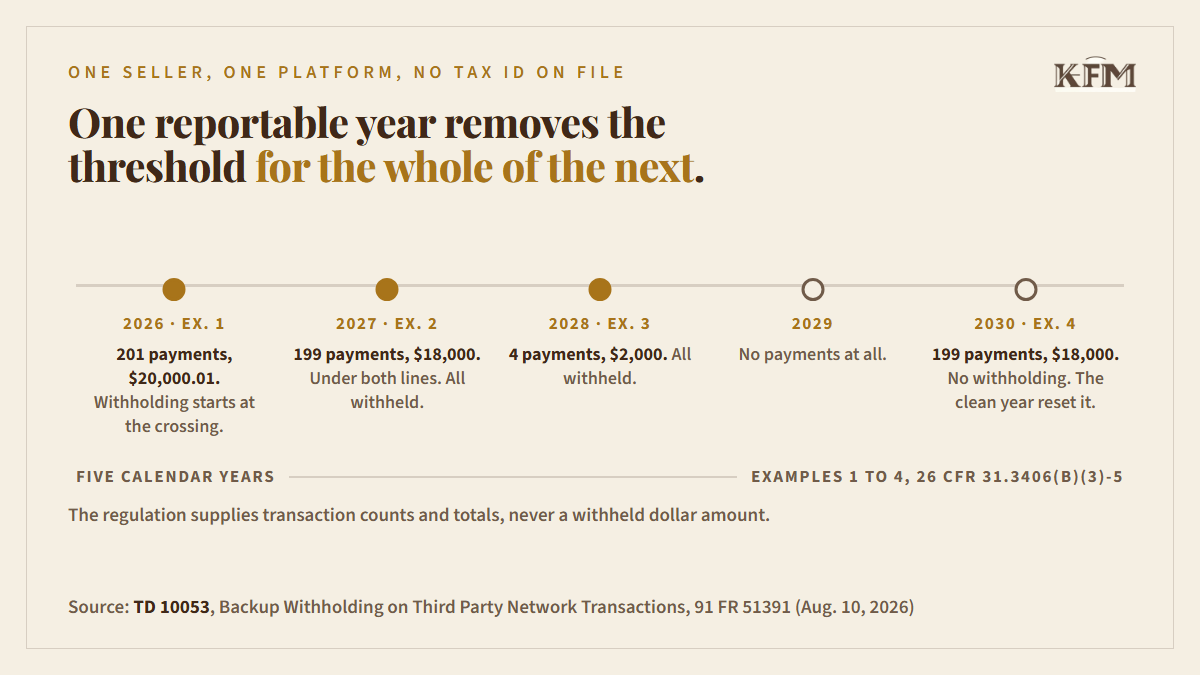
For a seller with no tax ID on file, the first year works like this. Withholding starts with the transaction that crosses the second of the two lines, and it takes the entire crossing payment, including the dollars under the line. In the regulation's Example 1, a seller runs 201 payments totaling $20,000.01 through a platform in 2026, and the platform withholds on the whole of the 201st transaction; the rule then reaches any payment after it that year.
The following year is where the rule tightens. The next paragraph of the regulation is headed "Exception," and what it switches off is the threshold screen itself: one reportable payment to you last year, and the screen is gone for the whole of this year. Example 2 shows it. In 2027 the same seller takes 199 payments totaling $18,000, under both lines, and the platform must withhold on every payment from the first dollar. Example 3 pushes it further: in 2028 the seller takes four payments totaling $2,000, and every one is still withheld on.
A clean year resets it. In Example 4 the seller runs nothing through the platform in 2029, and when 2030 brings another 199 payments and $18,000, no withholding is required, because the preceding year had no reportable payments.
Treasury was asked to apply all of this prospectively only and declined: the rule covers payments made in calendar years beginning after December 31, 2024, so it has governed 2025 and 2026 payments all along. Withheld amounts come back as a credit against your income tax when you file, the way paycheck withholding does. But that is your working capital sitting with the Treasury until the return goes in.
Every example in the regulation turns on the same omission: the platform asked for a tax ID the right way, and the seller never provided one. A correct SSN or EIN on file with every platform you take money through, before the fourth quarter pushes your counts up, and none of this machinery starts.
A threshold that decides whether a form gets filed is not a threshold that decides whether money gets taken.
If a platform has started holding back part of your payouts and you cannot tell why, reply and I will tell you the first thing to check.
Sources: TD 10053, Backup Withholding on Third Party Network Transactions, 91 FR 51391 (Aug. 10, 2026), amending 26 CFR 31.3406(a)-1 and 31.3406(b)(3)-5 - https://www.federalregister.gov/documents/2026/08/10/2026-16269/backup-withholding-on-third-party-network-transactions · IRC 3406(a)(1) (withholding at "the fourth lowest rate of tax applicable under section 1(c)") - https://www.law.cornell.edu/uscode/text/26/3406 · IRC 1 (rate tables behind the 24%) - https://www.law.cornell.edu/uscode/text/26/1 · IRC 6050W(e) ($20,000 / 200-transaction reporting threshold) - https://www.law.cornell.edu/uscode/text/26/6050W · IRC 31(c) (credit for backup-withheld amounts) - https://www.law.cornell.edu/uscode/text/26/31 · OBBBA secs. 70432(a), (b)(1), Pub. L. 119-21, 139 Stat. 72 (July 4, 2025) · REG-112829-25, 91 FR 934 (Jan. 9, 2026) (the proposal, adopted without change) - https://www.federalregister.gov/documents/2026/01/09/2026-00254/backup-withholding-on-third-party-network-transactions · KFM, "Fewer 1099s in 2026. The tax on that income is unchanged" (July 22, 2026) - https://kfmus.com/kfmblog/fewer-1099s-in-2026.-the-tax-on-that-income-is-unchanged
Comments