
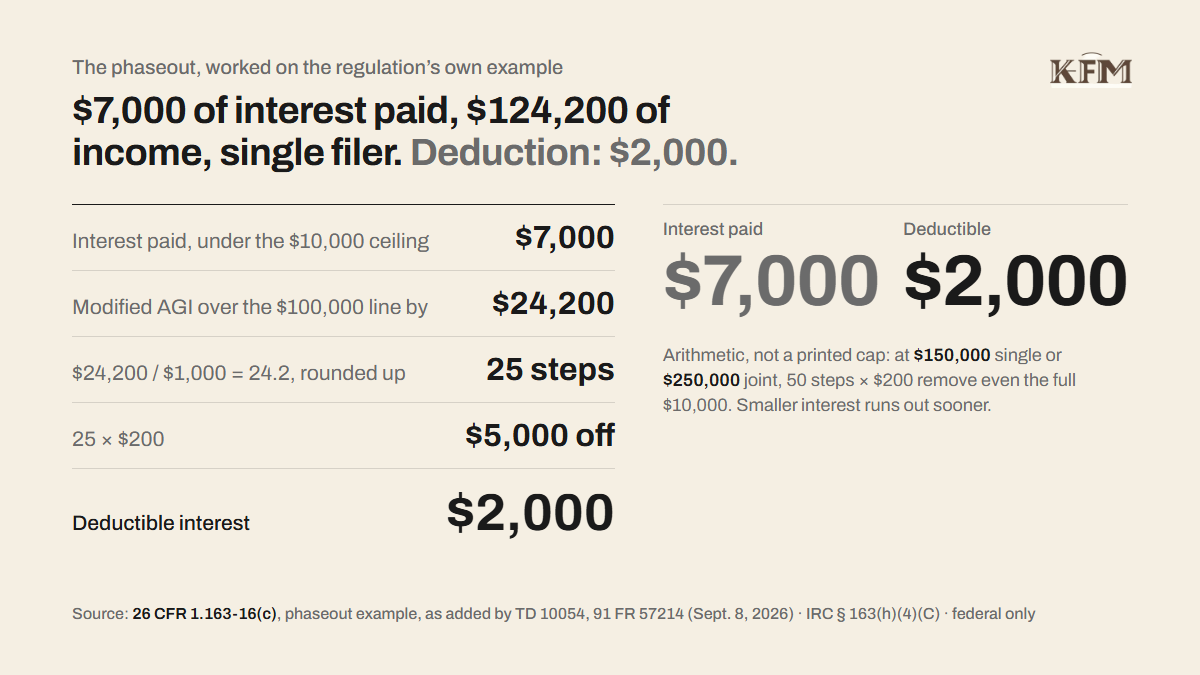
A single filer pays $7,000 of interest on a car loan in a year and earns $124,200. The deduction is $2,000. Those are the IRS's own numbers, from the example it wrote into the final car-loan regulations on September 8, and the $5,000 that disappeared went to the income phaseout.

Last year's tax law added section 163(h)(4) to the Code: up to $10,000 a year of interest on a personal car loan, for tax years 2025 through 2028. Section 63(b)(7) then subtracts it from adjusted gross income, which means you do not have to itemize to take it. Florida has no income tax, so for us it is a federal question only.
The regulations, final as of September 8 and effective November 9, hold the deduction to the statute's three gates.
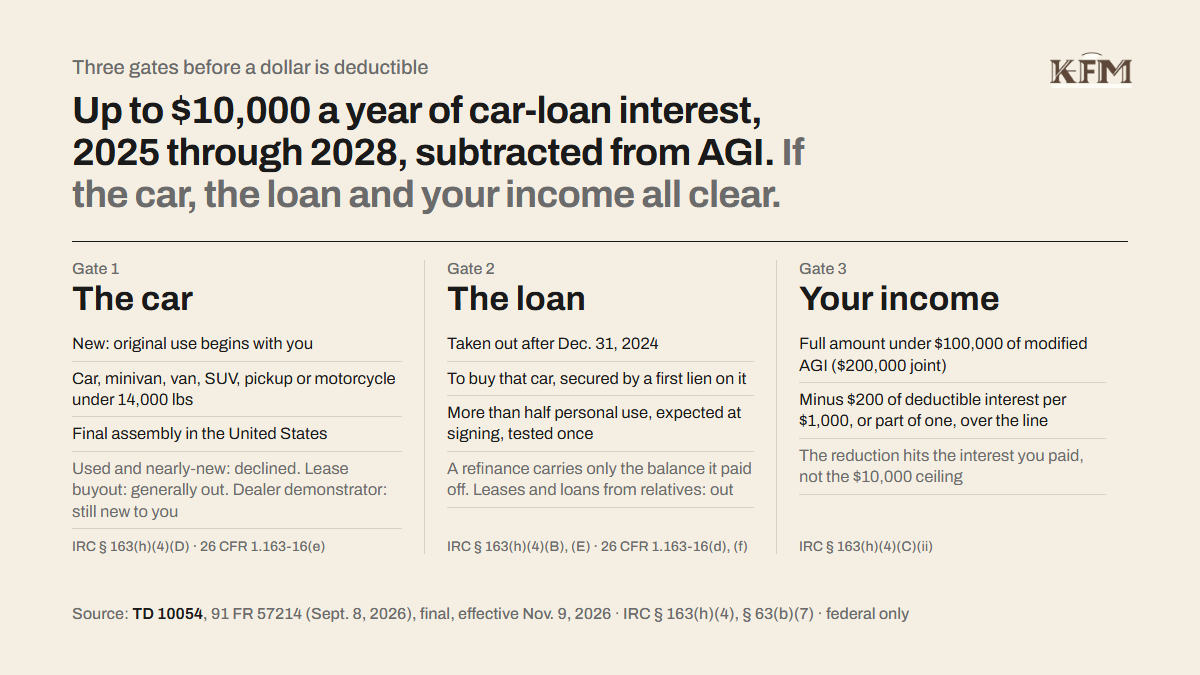
The first gate is the car. Its original use has to begin with you, which is the statute's way of saying new. It has to be a car, minivan, van, SUV, pickup, or motorcycle under 14,000 pounds, and its final assembly has to have taken place in the United States. Treasury was asked to let used and "nearly-new" vehicles in, and answered that doing so "would be in direct conflict with the plain language of the statute." A dealer's demonstrator still counts as new to the customer who buys it, because the dealer held it for sale. A leased car you buy at the end of the lease generally does not, because original use began with the lessor.
The second gate is the loan. It has to have been taken out after December 31, 2024, to buy that vehicle, and it has to be secured by a first lien on it. A loan from a relative is out; so is a lease. You have to expect, when you sign, that the car will be used more than half the time for personal purposes, and the regulations test that expectation once, at signing, rather than every year. A refinance keeps the deduction only up to the balance it paid off. Negative equity rolled in from the last car is treated as debt on the last car, which the regulations say would otherwise let people deduct interest on loans from before 2025.
The third gate is your income. Above $100,000 of modified adjusted gross income ($200,000 on a joint return) the deductible interest drops by $200 for every $1,000, or part of a $1,000, over the line. That is how the example's $7,000 became $2,000: $24,200 over the line rounds up to 25 steps, and 25 steps cost $5,000. The arithmetic runs out at $150,000 ($250,000 joint), where even the full $10,000 is gone, and it runs out sooner for anyone whose interest is smaller than that.
Your lender will report the interest on a new form, the 1098-VLI, and for 2025 the IRS let lenders satisfy that by posting a total to your account by January 31. The form tells you the interest. It does not tell you whether the car qualifies. The badge on the trunk does not either: the regulations point you to the assembly plant encoded in the VIN or to the final assembly point printed on the window label, and the VIN has to go on your return. Eligibility stays with the taxpayer.
Sources: TD 10054, Car Loan Interest Deduction, 91 FR 57214 (Sept. 8, 2026), adding 26 CFR 1.163-16 and 1.6050AA-1 - https://www.federalregister.gov/documents/2026/09/08/2026-18219/car-loan-interest-deduction · IRC 163(h)(4) (the deduction, the $10,000 limit, the phaseout, the vehicle and loan definitions) - https://www.law.cornell.edu/uscode/text/26/163 · IRC 63(b)(7) (subtracted from adjusted gross income without itemizing) - https://www.law.cornell.edu/uscode/text/26/63 · IRC 6050AA (lender reporting) - https://www.law.cornell.edu/uscode/text/26/6050AA · Notice 2025-57, 2025-45 I.R.B. 692 (2025 transitional reporting) - https://www.irs.gov/pub/irs-drop/n-25-57.pdf · Pub. L. 119-21, sec. 70203, 139 Stat. 72 (July 4, 2025) · REG-113515-25, 91 FR 67 (Jan. 2, 2026) (the proposal) - https://www.federalregister.gov/documents/2026/01/02/2025-24154/car-loan-interest-deduction
Comments