
The IRS does not have forever to assess more tax on a year you have already filed. There is a window, and when it closes, the year closes with it. The length of that window is written into the return itself.
"Assess" is the formal step. The IRS puts a number on its books as owed. Until the window on a year shuts, that year is still open business; after it shuts, the IRS generally cannot add to it.
The general rule is three years, counted from the day the return was filed (IRC § 6501(a)). A return filed early is treated as filed on the due date, so filing in February does not start the window any sooner than filing on April 15 (§ 6501(b)(1)). If you file your return on time, then three years after that tax year is closed.
The window stretches to six years on one condition. If the return leaves out gross income, and the amount left out is more than 25% of the gross income the return does show, the IRS gets six years instead of three (§ 6501(e)(1)(A)(i)). The base of that test is the gross income figure on the return, before deductions. If you report $200,000 and miss more than $50,000, the six-year window applies.
For a business the base is larger than profit. The statute says that for a trade or business, "gross income" for this test means the total amounts received or accrued from the sale of goods or services, before cost of goods sold comes off (§ 6501(e)(1)(B)(i)). A store with $2 million of sales and $1.5 million of cost of goods sold is measured against the $2 million. The 25% line sits at $500,000 of omitted receipts, not at $125,000. Figure 1 runs the arithmetic for both cases.
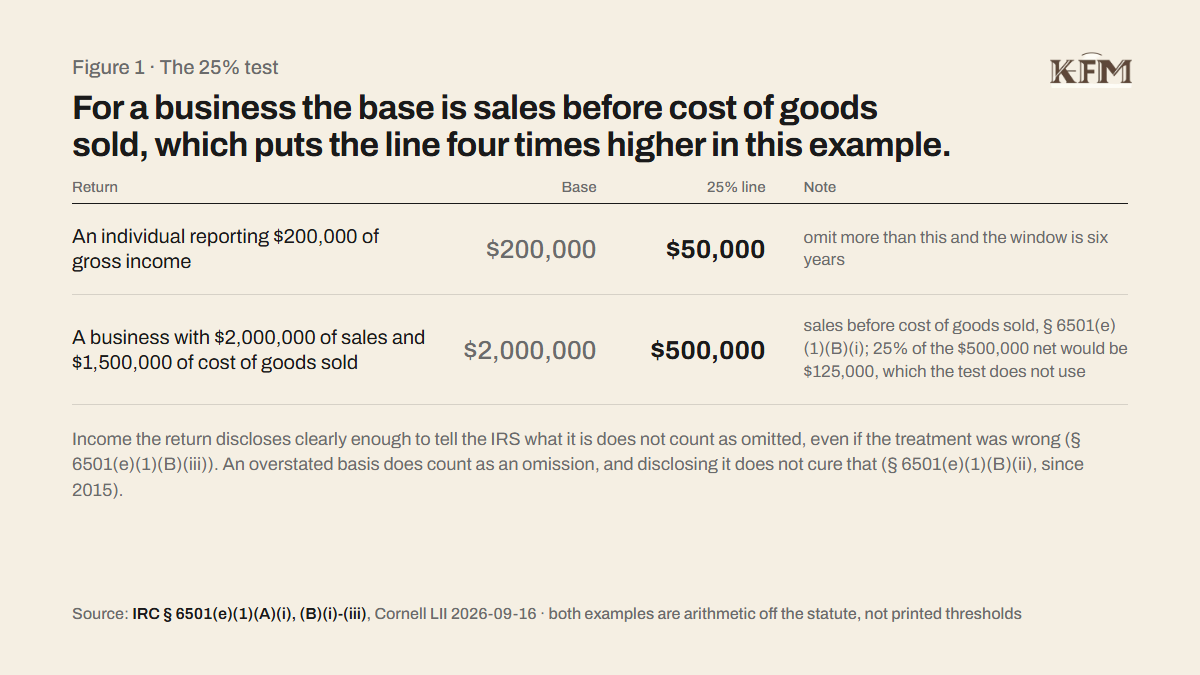
Two further rules decide what counts as omitted. Income that the return, or a statement attached to it, discloses clearly enough to tell the IRS what it is does not count toward the 25%, even if the tax treatment was wrong (§ 6501(e)(1)(B)(iii)). A return that shows its work keeps the three-year window. One exception was added in 2015. Overstating what you paid for an asset, its basis, counts as omitting income, and disclosing that basis figure does not undo it (§ 6501(e)(1)(B)(ii) and (iii)). Sell a property with too high a cost on the return and you have understated the gain in a way the disclosure rule does not reach.
Above six years there is a third window, and it never closes. A false or fraudulent return filed with intent to evade tax can be assessed at any time (§ 6501(c)(1)). So can a willful attempt to evade the tax (§ 6501(c)(2)). And where no return was filed, the three years never began, so the year stays open indefinitely (§ 6501(c)(3)). Figure 2 lays the three windows side by side.
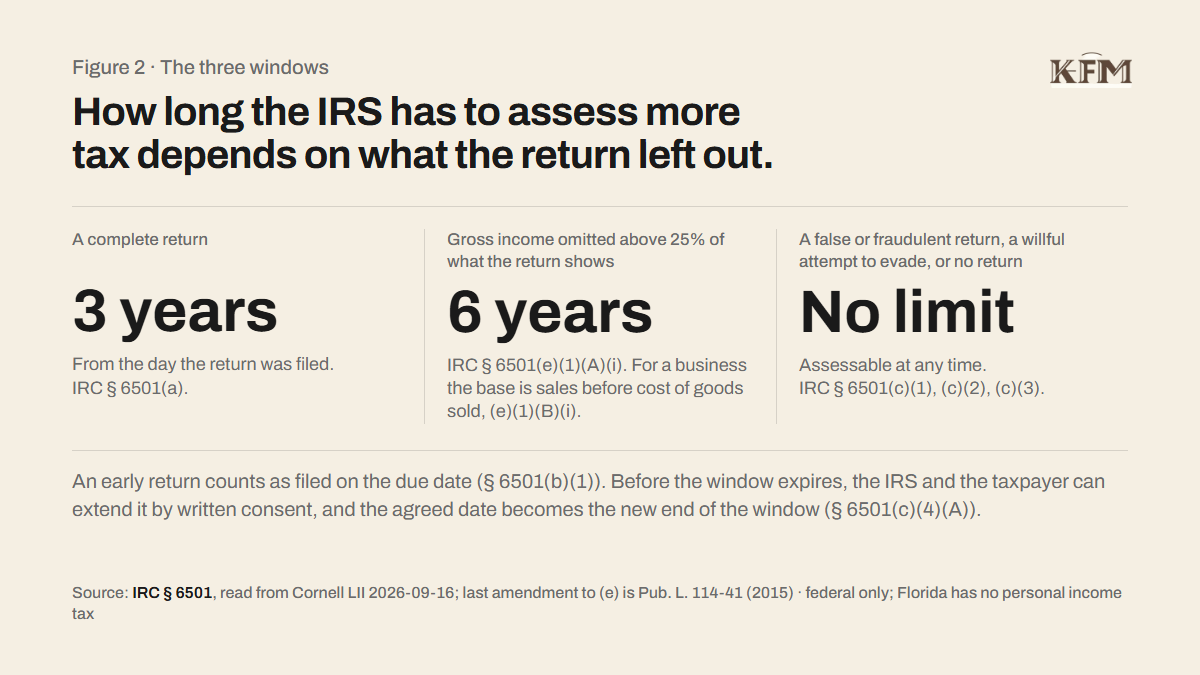
The window can also move by agreement. Before it expires, the IRS can ask you to extend it in writing, and if you consent, the date you both signed becomes the new end of the window (§ 6501(c)(4)(A)). The request usually arrives during an examination, and it is a consent, not an order.
All of this is federal. Florida has no personal income tax, so an individual Florida filer has no separate state window running alongside it.
The window is settled before the IRS ever looks at the return. File it, report the gross income, disclose the items you are unsure about, and you have the three-year window. Six years and forever are reserved for large omissions, fraud, and missing returns.
Sources: IRC § 6501: § 6501(a) (3-year general rule), § 6501(b)(1) (early return treated as filed on the due date), § 6501(e)(1)(A)(i) (25% omission, 6-year window), § 6501(e)(1)(B)(i) (gross income of a trade or business means sales before cost of goods sold), § 6501(e)(1)(B)(ii) (basis overstatement is an omission), § 6501(e)(1)(B)(iii) (disclosed amounts do not count, except a basis overstatement), § 6501(c)(1)-(3) (false or fraudulent return, willful evasion, no return: assessable at any time), § 6501(c)(4)(A) (extension by written consent). https://www.law.cornell.edu/uscode/text/26/6501
Comments