
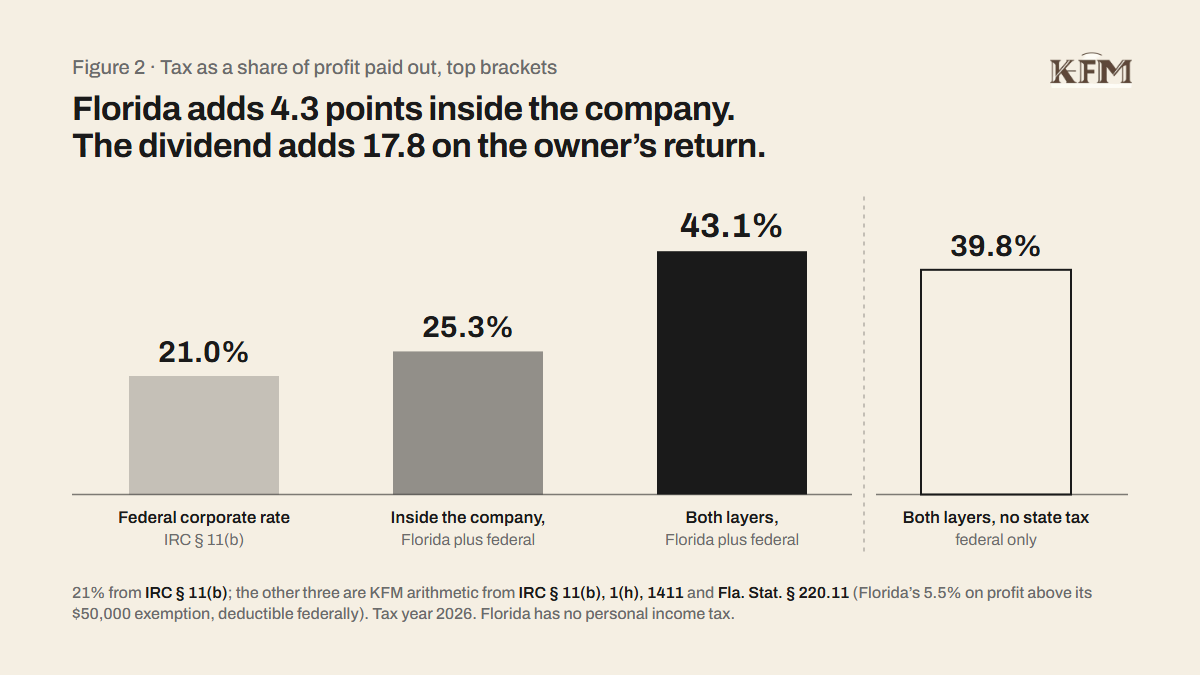
The federal income tax on a corporation is a flat 21% of its taxable income, and has been since 2018. For the owner of a C corporation, a company that pays its own income tax, it is the first of two layers of tax on the same profit.
The second arrives when the profit is paid out. A dividend, the company's after-tax profit paid to its shareholders, is income on the owner's own return and is taxed there.
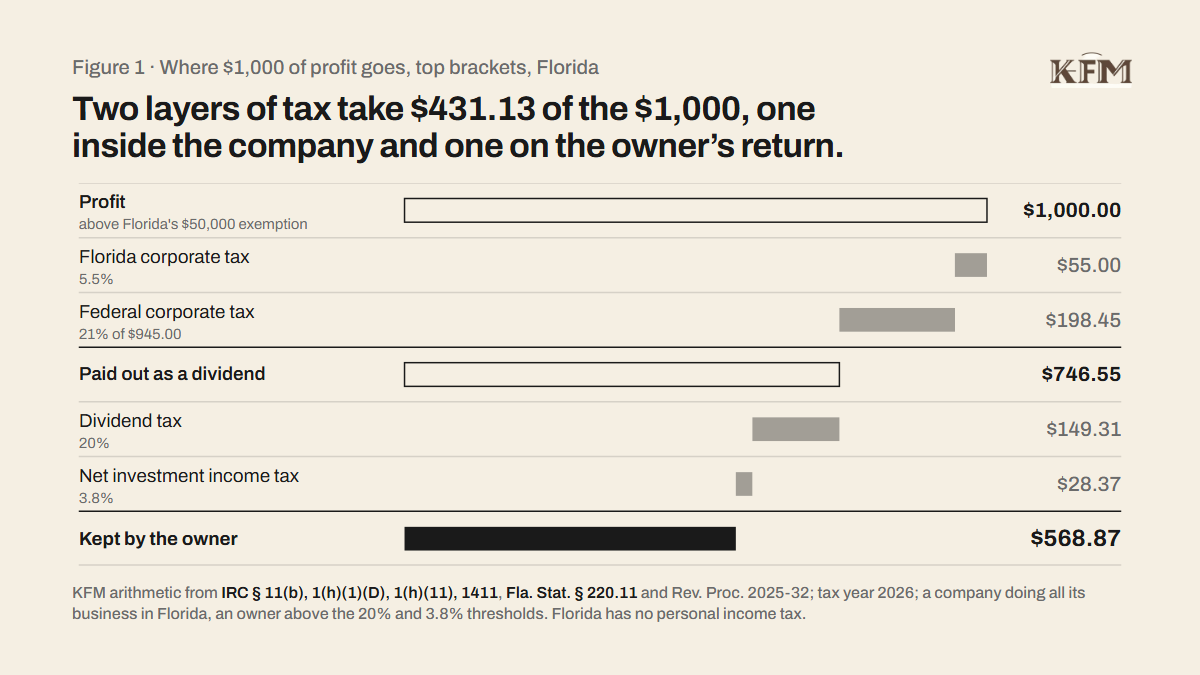
In Florida the first layer has two parts. The state taxes corporate income at 5.5%, and the first $50,000 of net income is exempt. The federal 21% then applies to what remains after the state tax, because the company deducts state income tax on its federal return. Take $1,000 of profit above Florida's exemption at a company doing all its business in the state. It pays $55.00 to Florida and $198.45 to the IRS and has $746.55 left.
Paid out, the $746.55 is taxed as a qualified dividend, at the same rates as long-term capital gains: 0%, 15% or 20%. For 2026 the 20% rate reaches the part of taxable income above $613,700 on a joint return, or $545,500 for a single filer. On top of that comes the 3.8% net investment income tax, once modified adjusted gross income passes $250,000 on a joint return ($200,000 single), and dividends count toward it. It applies even when the owner works in the business day to day; the IRS's own lawyers said so in 2021, in advice that is not binding precedent. An owner at the top pays $149.31 and $28.37 on this dividend. Florida has no personal income tax, so for a Florida resident the second layer is federal only.
The owner keeps $568.87 of the original $1,000. The two layers together take $431.13, or 43.1%, by our arithmetic from the rates above. Without Florida's 5.5%, the federal layers come to 39.8%, so most of the distance from 21% is the second layer.
Owners in lower brackets pay 15% or 0% on the dividend, and below the $250,000 joint or $200,000 single threshold the 3.8% does not apply, so their second layer is smaller.
Leaving the profit in the company delays the second layer until the money comes out, as a dividend or as capital gain when the shares are sold. The tax law also limits how much profit can sit there for that reason. A company that keeps profit beyond the reasonable needs of the business, to spare its shareholders income tax, can owe a 20% accumulated earnings tax on it. The first $250,000 of accumulated earnings is safe from this tax, or $150,000 for a company whose main work is in health, law, engineering, architecture, accounting, actuarial science, performing arts or consulting.
When you weigh a C corporation, count both layers. At the top, in Florida, they take 43.1 cents of each dollar of profit the company pays out.
Sources: IRC 11(b) - https://www.law.cornell.edu/uscode/text/26/11 · IRC 1(h)(1)(B)-(D), (h)(11) - https://www.law.cornell.edu/uscode/text/26/1 · Rev. Proc. 2025-32, sec. 4.03 (2026 maximum 15% rate amounts), IRB 2025-45 - https://www.irs.gov/pub/irs-drop/rp-25-32.pdf · IRC 1411(a)(1), (b), (c)(1)(A)(i) - https://www.law.cornell.edu/uscode/text/26/1411 · CCA 202118009 (2021, not precedent) - https://www.irs.gov/pub/irs-wd/202118009.pdf · IRC 164(a)(3) - https://www.law.cornell.edu/uscode/text/26/164 · IRC 531 - https://www.law.cornell.edu/uscode/text/26/531 · IRC 532(a) - https://www.law.cornell.edu/uscode/text/26/532 · IRC 533(a) - https://www.law.cornell.edu/uscode/text/26/533 · IRC 535(c)(2) - https://www.law.cornell.edu/uscode/text/26/535 · Fla. Stat. 220.11(2) - https://www.flsenate.gov/Laws/Statutes/2026/220.11 · Fla. Stat. 220.1105(5) - https://www.flsenate.gov/Laws/Statutes/2026/220.1105 · Fla. Stat. 220.13(1)(a) - https://www.flsenate.gov/Laws/Statutes/2026/220.13 · Fla. Stat. 220.14(1) - https://www.flsenate.gov/Laws/Statutes/2026/220.14 · Fla. Const. art. VII, sec. 5(a) - https://www.flsenate.gov/Laws/Constitution

Comments